
Feedforward Neural Network example with Simple Python
Example: Simple Feedforward Process (1 hidden layer)
Let’s say we have 2 inputs and 1 output:
- Inputs: x1,x2
- Hidden Neurons: h1,h2
- Output Neuron: o
Forward Flow:
Input Layer:     x1     x2
                    \   /
Hidden Layer:     h1   h2
                     \ /
Output Layer:         o
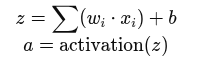
Each connection has a weight, and each neuron applies:
Python Simulation (Simple Example)
import numpy as np

def sigmoid(x):
    return 1 / (1 + np.exp(-x))

# Inputs
X = np.array([0.5, 0.8])

# Weights and biases for hidden layer (2 neurons)
W_hidden = np.array([[0.1, 0.3],
                     [0.4, 0.2]])
b_hidden = np.array([0.05, 0.1])

# Weights and bias for output layer
W_output = np.array([0.6, 0.9])
b_output = 0.2

# Hidden layer calculation
z_hidden = np.dot(W_hidden, X) + b_hidden
a_hidden = sigmoid(z_hidden)

# Output layer calculation
z_output = np.dot(W_output, a_hidden) + b_output
a_output = sigmoid(z_output)

print("Predicted Output:", a_output)
Summary Table
| Concept | Description |
|---|---|
| Feedforward Flow | Data moves from input → hidden → output |
| Layers | Input, Hidden (optional), Output |
| Weights + Biases | Parameters learned during training |
| Activation Functions | Add non-linearity (e.g., ReLU, Sigmoid) |
| Loss Function | Measures prediction error |
| Gradient Descent | Optimization method to reduce loss |
Next – Hidden Layer Influence